HUMB1001 · Integrated Systems Anatomy and Physiology
Module 1
Control of Body Systems

How the nervous and endocrine systems keep the body working as one
→Next / continueSpacePause or resume narrationTShow transcriptFFull screen

In this lecture

  1. Two control systems
  2. Conscious or automatic?
  3. The brain's automatic centres
  4. Where the systems meet
  5. How hormones talk to cells
  6. Keeping hormones in range
  7. A tour of the endocrine glands
Acknowledgement of Country (Boodja). I would like to acknowledge the Whadjuk Noongar people whose land we are standing on and recognise the strength, resilience and capacity of the Noongar people where Curtin University is situated. I pay my respect to their vibrant and endless culture and the leadership of the Elders past, present and future. This country (boodja) where Curtin University is situated has belonged to the Whadjuk Noongar people for thousands of years and is a place of learning for all people now and Curtin University is very proud to continue on this very long tradition.
WARNING. This material has been reproduced and communicated to you by or on behalf of Curtin University in accordance with section 113P of the Copyright Act 1968 (the Act). The material in this communication may be subject to copyright under the Act. Any further reproduction or communication of this material by you may be the subject of copyright protection under the Act. Do not remove this notice.

Press → to continue

What you'll be able to do

Two control systems
Nervous vs endocrine: speed, reach, duration
Conscious or automatic?
Pathways to the cortex, and the reflex arc
Mapping the brain
Cerebral lobes · brainstem · diencephalon
Where the systems meet
Hypothalamus → pituitary, two routes
How hormones work
Chemistry decides transport and action
Keeping hormones in range
Feedback loops and the major glands

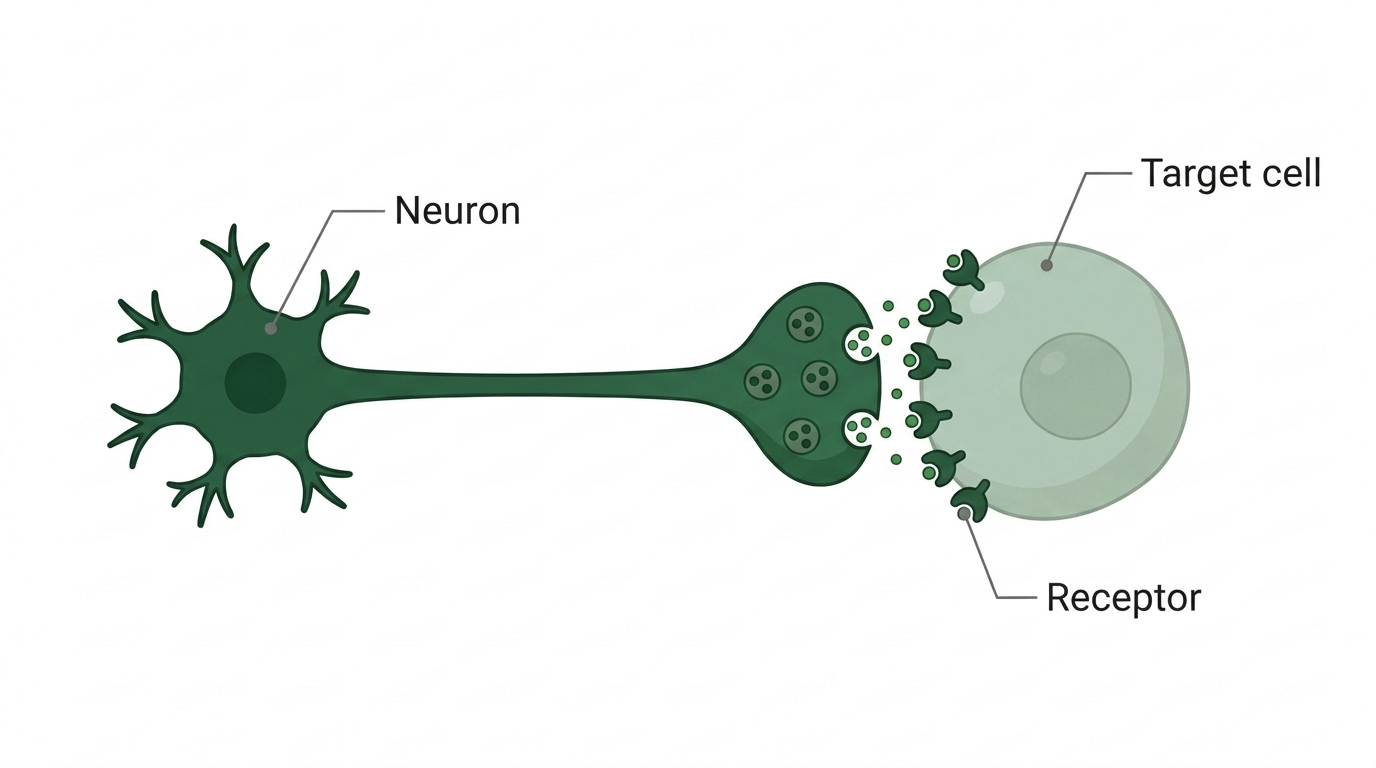
Two ways to send a message

One system uses wires. The other broadcasts.

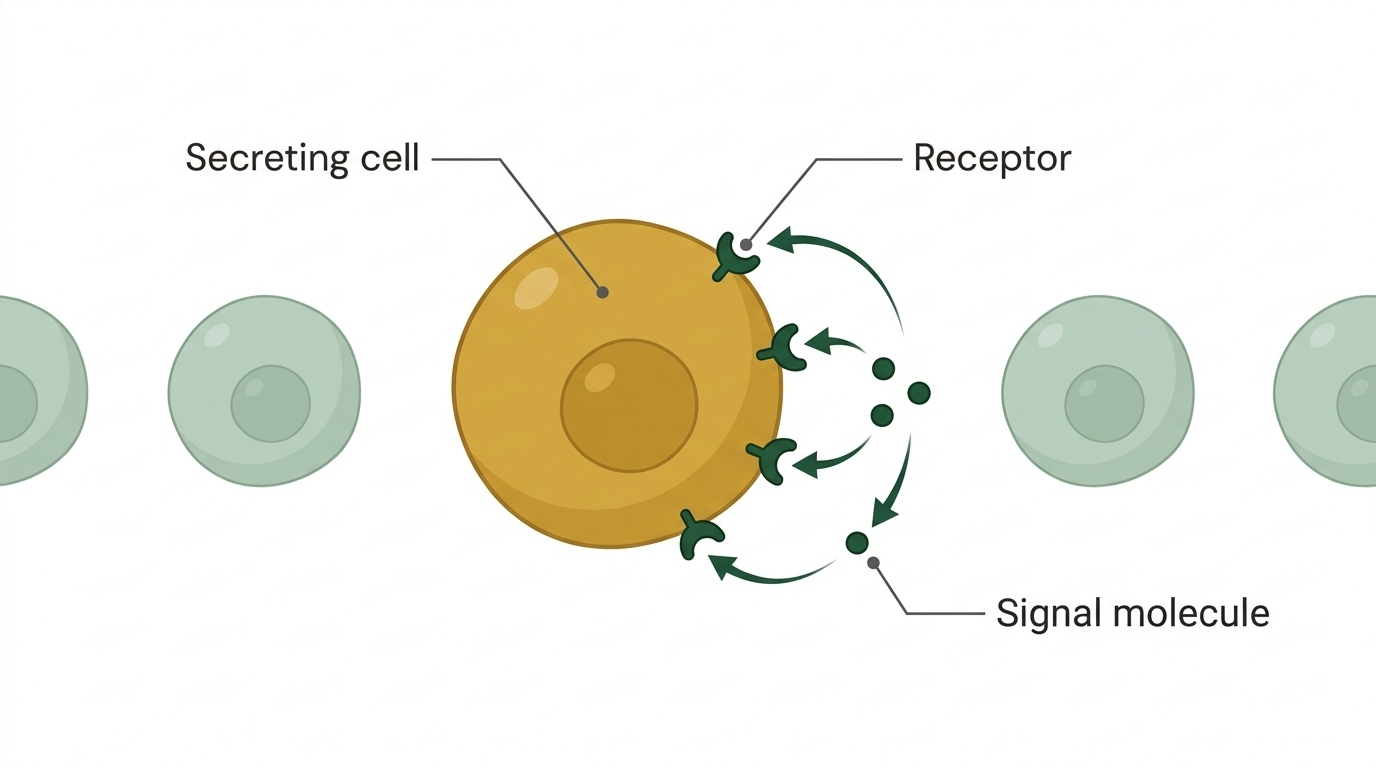
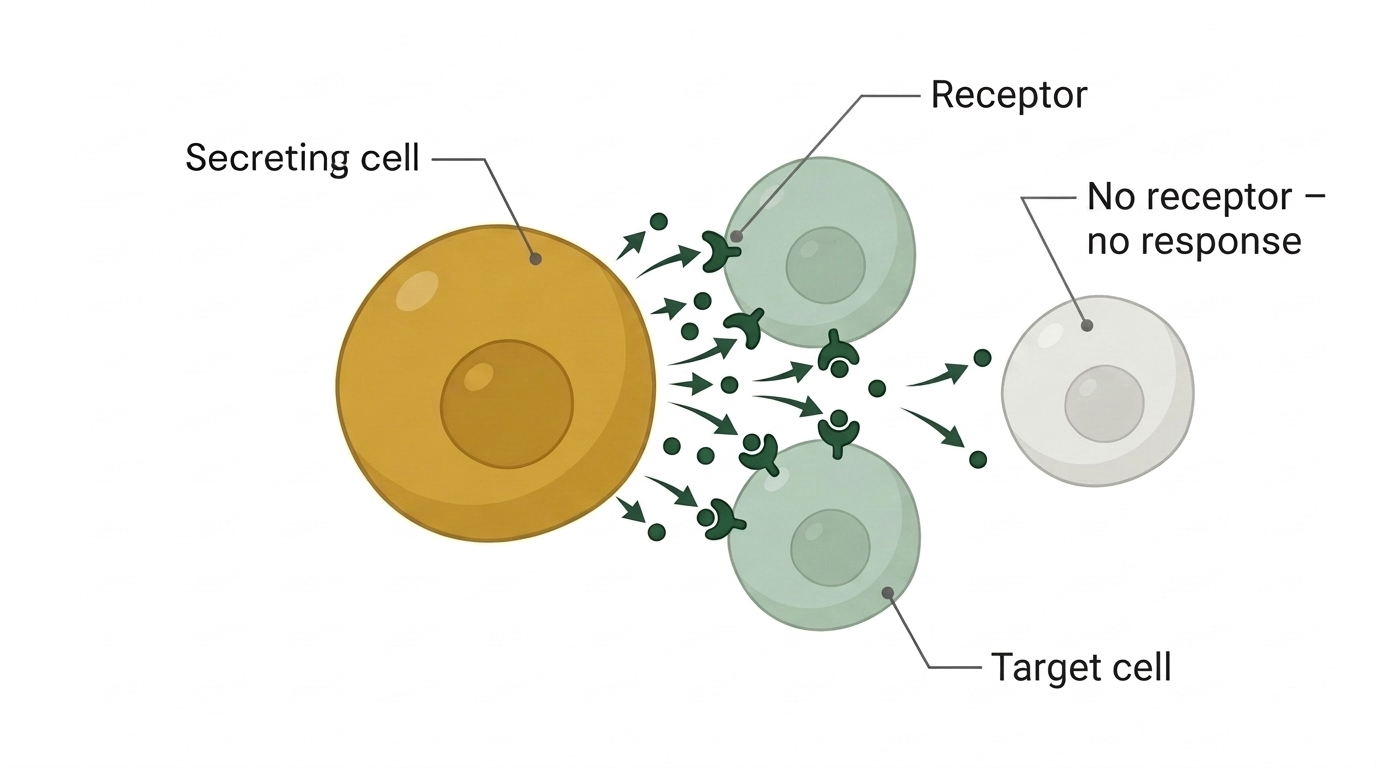
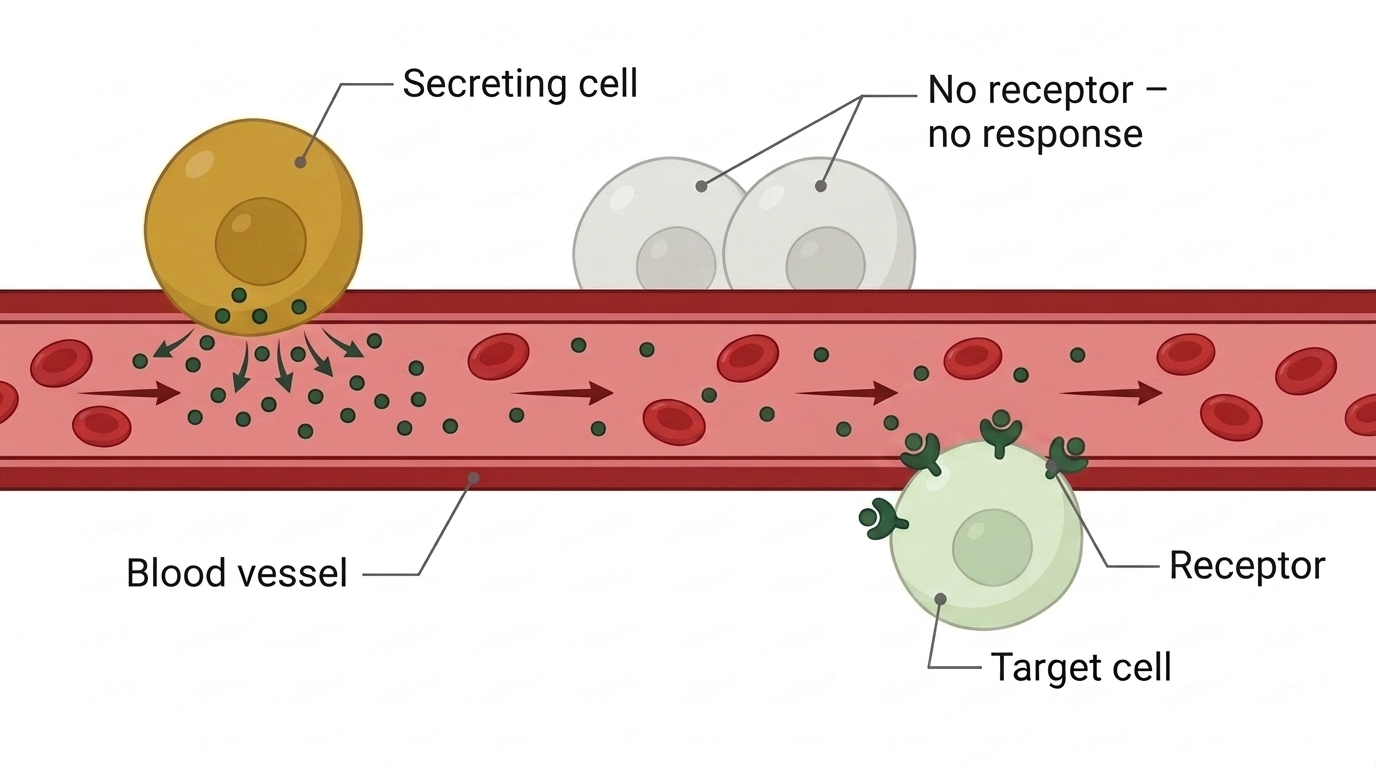
Only cells with the right receptor are listening.

Nervous vs endocrine

FeatureNervousEndocrine
Messenger
Action potentials + neurotransmitters
Hormones
Route
Along neurons, to one target
In the blood, body-wide
Speed
Milliseconds
Seconds or longer
Duration
Brief
Minutes to years
Who responds
Cells the neuron contacts
Any cell with the receptor
Which pair matches each response to the system that mainly controls it?Response 1: your pupils constrict in bright sunlight · Response 2: you grow taller over the years of puberty

How confident are you?

Pupil constriction is a reflex. It's fast, brief and aimed at one target, the smooth muscle of the iris, so it's a job for neurons. Growing taller takes years and needs tissues all over the body to respond, especially bone and muscle, so it's a job for a hormone (growth hormone).
Compare the two responses using the table you've just seen. Your pupils adjust in a fraction of a second and only one small muscle is involved, which points to the nervous system. Growth takes years and involves almost every tissue, which points to a hormone (growth hormone).

Press → to continue

Section 2
Conscious or automatic?

How the nervous system controls the body

The nervous system has two parts

BrainSpinal cordCranial nervesSpinal nerves

Four major regions

CerebrumDiencephalonBrainstemCerebellum

Lobes of the cerebrum

Frontal
Voluntary movement · planning · personality
Parietal
Body sensation: touch, pain, temperature
Temporal
Hearing · smell · memory
Occipital
Vision
Insula
Taste · sensations from the viscera

The cerebral cortex

A thin sheet, heavily folded.

Folding = more grey matter in the same skull.

Feeling something: the conscious sensory route

Receptor
Detects the stimulus
Sensory neuron
Into the spinal cord
Ascending tract
Up the spinal cord, through the brainstem
Thalamus
Relay and filter
Cerebral cortex
Conscious awareness

Deciding to move: the conscious motor route

Motor cortex
The decision to move
Descending tract
Through the brainstem, down the cord
Synapse
Onto a motor neuron
Motor neuron
Out through a spinal nerve
Effector
Skeletal muscle contracts

Conscious control has a cost

Every synapse adds a delay.

Sometimes the body can't wait for a decision.

What makes a reflex a reflex?

Involuntary
No decision involved
Rapid
Few synapses
Predictable
Same stimulus, same response
Unlearnt
Built in, not practised

The reflex arc

Receptor
Detects the stimulus
Sensory neuron
Carries it into the CNS
Integration centre
Spinal cord or brainstem
Motor neuron
Carries the command out
Effector
Muscle or gland responds

You step on a drawing pin and lift your foot. Put the reflex arc in order.

Drag the steps into order, first at the top, or use the arrow buttons.

  1. ⋮⋮Leg flexor muscles contract
  2. ⋮⋮Pain receptor in the sole of the foot
  3. ⋮⋮Motor neuron to the leg
  4. ⋮⋮Sensory neuron to the spinal cord
  5. ⋮⋮Interneuron in the spinal cord grey matter
Correct. That's the arc: receptor → sensory neuron → integration centre → motor neuron → effector. The spinal cord handles this one without the brain.
Not quite. Follow the signal: it has to be detected first, carried into the CNS, processed there, carried back out, and only then can anything happen.

Press → to continue

Somatic vs autonomic reflexes

FeatureSomaticAutonomic (visceral)
Effector
Skeletal muscle
Smooth muscle, cardiac muscle, glands
Purpose
Protection, balance and posture
Keeping internal conditions stable
Integration centre
Spinal cord or brain
Spinal cord or brainstem
Examples
Knee-jerk, withdrawal
Heart rate, blood pressure, pupil size, bladder emptying

Drag each reflex into the correct category.

Drag each item, or click it and then click where it goes

Heart rate slows when blood pressure rises
Knee-jerk when the patellar tendon is tapped
Pupils constrict in bright light
Staying upright when the bus brakes
Pulling your hand off a hot pan
Salivating at the smell of food
Bladder contracts when full
Somatic
Autonomic
All correct. Skeletal muscle means somatic; smooth muscle, cardiac muscle or a gland means autonomic.
Not quite yet. The ones outlined in red are in the wrong place. Ask yourself which effector responds. Is it skeletal muscle, or smooth muscle, cardiac muscle or a gland?

Press → to continue

Section 3
The brain's automatic centres

Brainstem and diencephalon

The brainstem

Medulla oblongata
Heart rate · blood vessel diameter · breathing rhythm · cough, sneeze, swallow, vomit
Pons
The “bridge” · REM sleep · helps set breathing
Midbrain
Visual and auditory reflexes · pupil reflex · steadying movement

The diencephalon

Thalamus
Sensory relay and filter
Epithalamus
Pineal gland · melatonin · daily rhythms
Hypothalamus
Homeostatic control centre

The hypothalamus runs homeostasis

Body temperature
Heat loss vs heat gain
Sleep–wake cycles
The body's master clock
Food intake
Hunger and fullness
Water balance
Thirst and water retention
Autonomic control
Heart, smooth muscle, glands
Pituitary control
Directs the endocrine system
1 2 3 4 5 6 7

A patient has damage that affects their heart rate, blood pressure and breathing rhythm. Click the region most likely to be involved.

Click a numbered marker.

Section 4
Where the systems meet

The hypothalamus and the pituitary gland

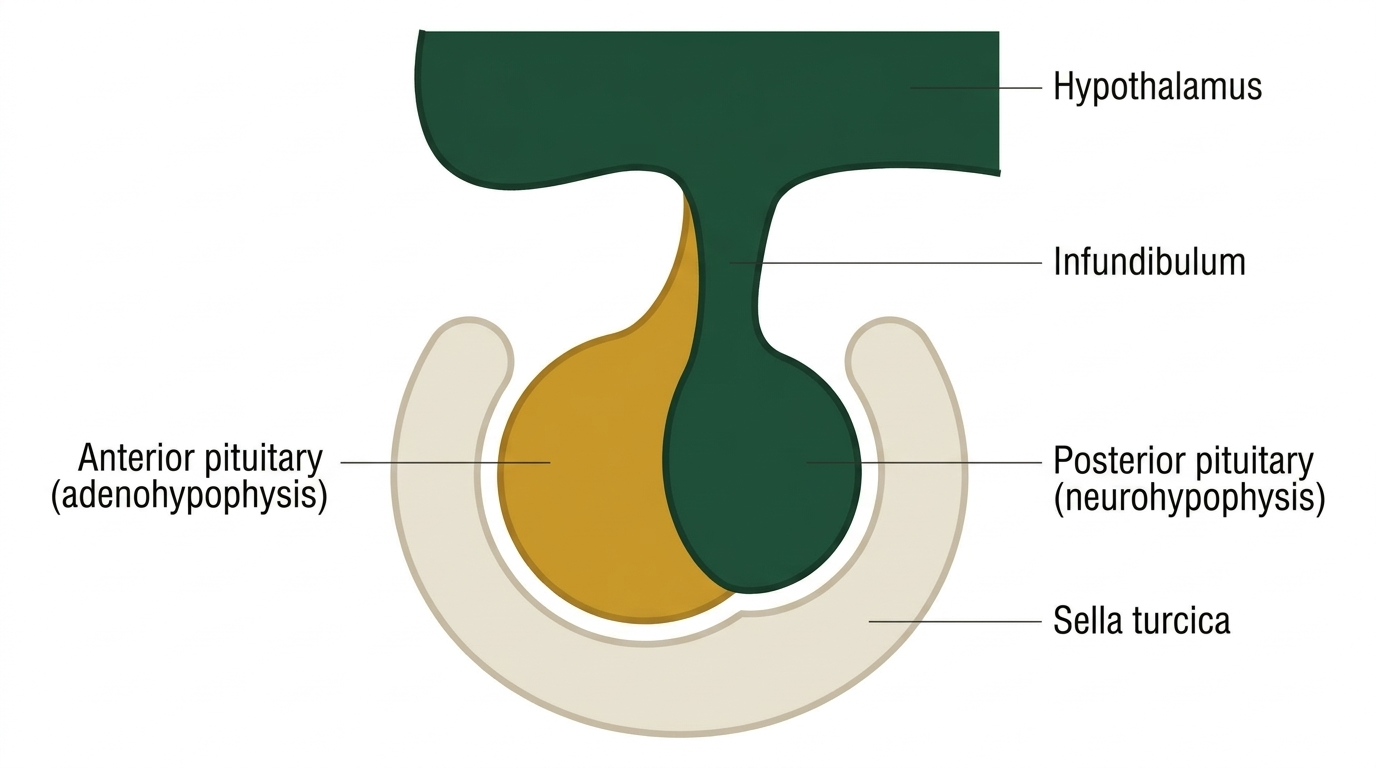
Two routes from the hypothalamus

Releasing & inhibiting hormones
Made by hypothalamic neurons
Portal system
A private blood route down the stalk
Anterior pituitary responds
Releases its own hormones
Neurosecretory cells
Hormone made in the hypothalamus
The tract
Carried down axons in the stalk
Posterior pituitary releases
Stored, then released on a nerve signal

Anterior vs posterior pituitary

FeatureAnterior (adenohypophysis)Posterior (neurohypophysis)
Tissue
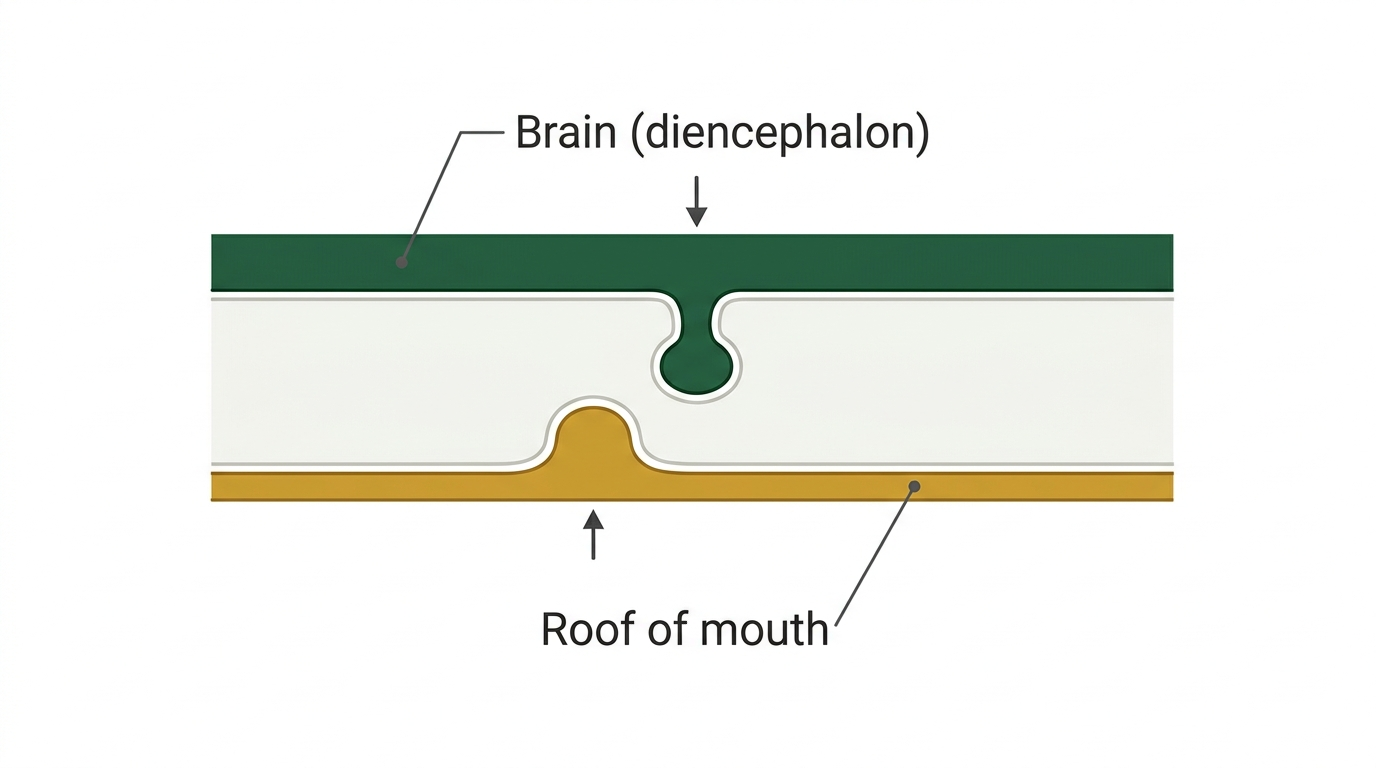
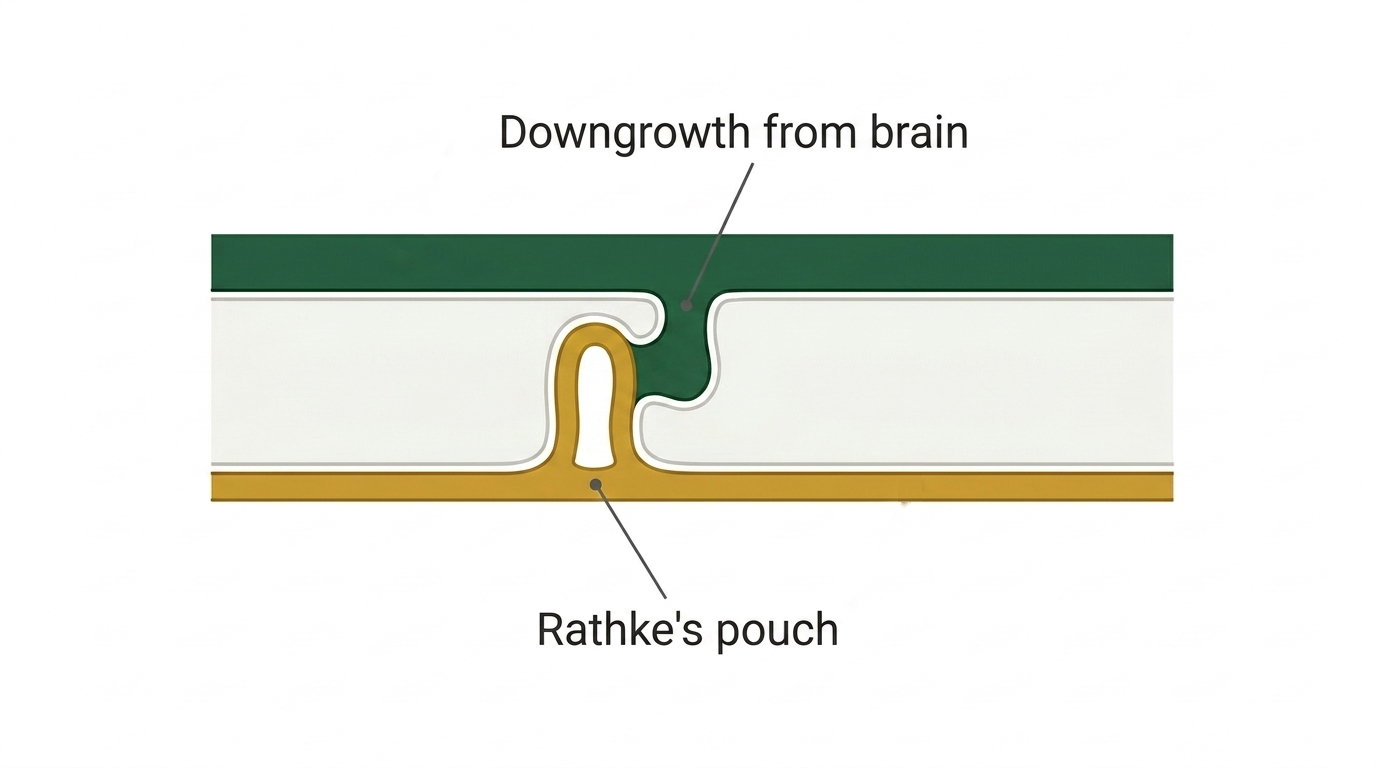
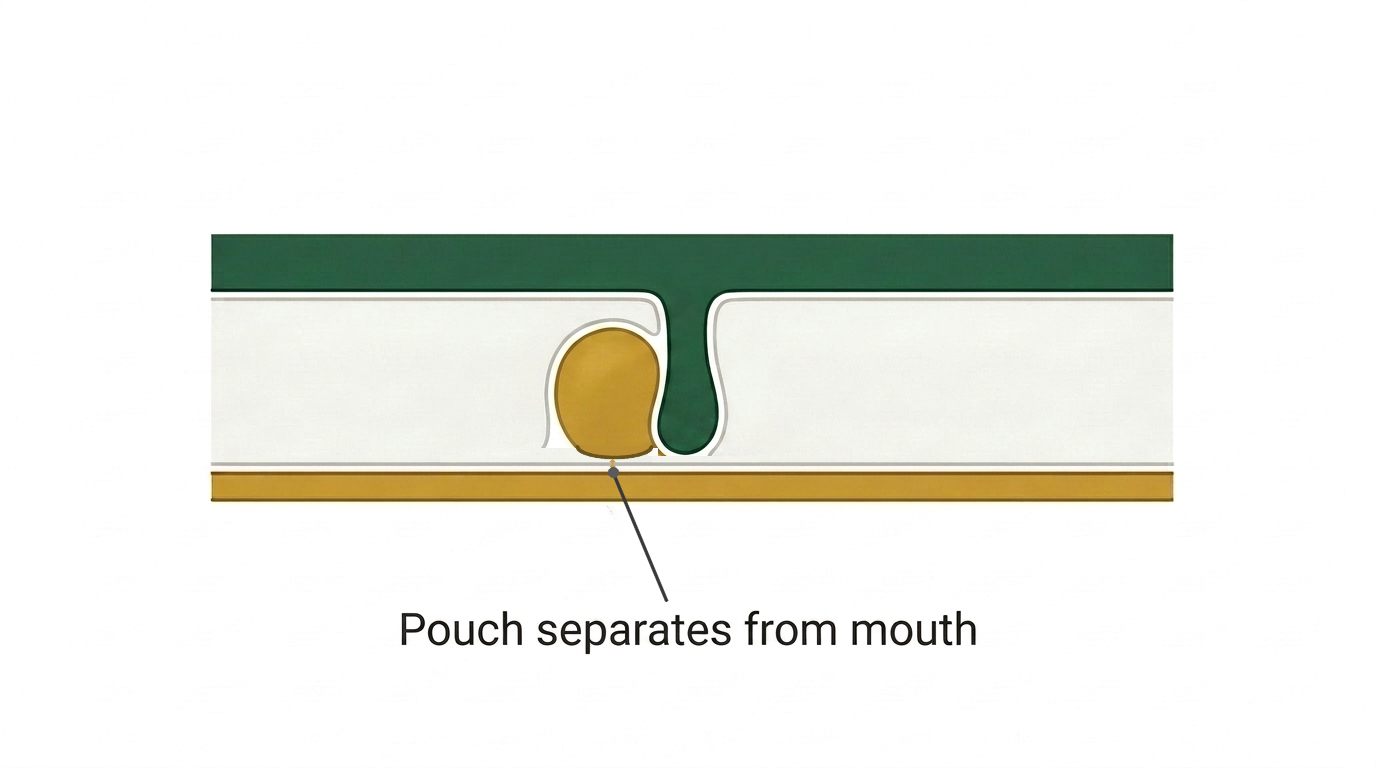
Glandular, from roof of mouth
Neural, from brain
Size
70–80% of gland
20–30% of gland
Link to hypothalamus
Blood: portal system
Nerves: tract
Hormones made
In the anterior pituitary
In the hypothalamus
Number of hormones
Seven
Two

Seven anterior pituitary hormones ★ = tropic

Growth hormone (GH)
Most body tissues
Thyroid-stimulating hormone (TSH) ★
Thyroid gland
Adrenocorticotropic hormone (ACTH) ★
Adrenal cortex
Follicle-stimulating hormone (FSH) ★
Ovaries and testes
Luteinising hormone (LH) ★
Ovaries and testes
Prolactin
Mammary glands
Melanocyte-stimulating hormone (MSH)
Skin melanocytes

Two posterior pituitary hormones

Antidiuretic hormone (ADH)
Kidneys hold on to water
Oxytocin
Uterus and mammary glands

Drag each hormone to its main target.

Drag each item, or click it and then click where it goes

LH
Prolactin
GH
ADH
MSH
ACTH
Oxytocin
FSH
TSH
Most body tissues
Thyroid gland
Adrenal cortex
Ovaries and testes (×2)
Mammary glands (milk production)
Skin melanocytes
Kidneys
Uterus (contractions)
All correct. ADH and oxytocin come from the posterior pituitary; the rest come from the anterior pituitary.
Not quite yet. The ones outlined in red are in the wrong place. Many of these names tell you the target. Look inside the name: “thyroid-stimulating”, “adrenocorticotropic”, “antidiuretic”.

Press → to continue

Section 5
How hormones talk to cells

Chemistry decides everything

Endocrine vs exocrine glands

FeatureEndocrineExocrine
Ducts
None: ductless
Yes
Secretes into
Tissue fluid → blood
A surface or cavity, via the duct
Product
Hormones
Sweat, saliva, tears, mucus, enzymes
Examples
Pituitary, thyroid, ovaries, testes
Sweat, salivary, lacrimal, mucous glands

Solubility decides everything

FeatureWater-solubleLipid-soluble
Chemical class
Proteins, peptides, most amino-acid derivatives
Steroids (from cholesterol) + thyroid hormones
Examples
All pituitary hormones, insulin, glucagon, adrenaline
Cortisol, aldosterone, testosterone, oestrogen, T3/T4
In the blood
Dissolved, free in plasma
Bound to a carrier protein
How long it lasts
Minutes; broken down quickly
Longer; protected by its carrier
Receptor
On the cell membrane
Inside the cell
Mechanism
Indirect (second messenger)
Direct (acts on genes)

The direct mechanism

1Diffuses through the membrane
2Binds its receptor inside the cell
3Hormone–receptor complex binds DNA
4Gene switched on → mRNA
5New proteins change the cell

The indirect (second-messenger) mechanism

1Hormone binds a surface receptor
2G protein activated
3Adenylate cyclase switched on
4ATP → cAMP (second messenger)
5Protein kinases → cell responses
6cAMP broken down → effect stops

Sort each hormone by where its receptor is.

Drag each item, or click it and then click where it goes

Adrenaline
TSH
Testosterone
Glucagon
Parathyroid hormone
Insulin
Aldosterone
Cortisol
ADH
T3 / T4 (thyroid hormones)
Oestrogen
Receptor inside the cell (direct)
Receptor on the membrane (indirect)
All correct. Did T3/T4 and adrenaline catch you out? Both are made from a single amino acid, but T3/T4 behave like lipid-soluble hormones and adrenaline doesn't.
Not quite yet. The ones outlined in red are in the wrong place. First ask: is it a steroid, a thyroid hormone, or made from amino acids? Then ask: can it cross a lipid membrane?

Press → to continue

Section 6
Keeping hormones in range

What switches hormone release on and off?

Three triggers for hormone release

Humoral
The gland senses the blood directly · e.g. low Ca²⁺ → PTH
Neural
Nerves stimulate the gland · e.g. sympathetic → adrenaline
Hormonal
Another hormone stimulates it · e.g. TSH → T3/T4

Two kinds of feedback

Negative feedback reverses a change. Positive feedback amplifies it.

Positive feedback needs an end point.

A direct loop: glucose and insulin

1Blood glucose rises
2Pancreatic beta cells detect it
3Insulin released
4Cells take up glucose
5Glucose falls → insulin release falls

An indirect loop: the thyroid axis

Hypothalamus → TRH
Releasing hormone, via the portal system
Anterior pituitary → TSH
A tropic hormone
Thyroid → T3 and T4
Into the blood
Body cells
Metabolic rate rises
Negative feedback
T3/T4 inhibit the hypothalamus and pituitary

Break the axis

Hypothalamus Anterior pituitary Thyroid gland Body cells TRHTSHT3 / T4 –– Negative feedback
TRH
TSH
T3 / T4
Metabolic rate

Shaded band = normal range

1 · Choose a scenario

2 · Predict: what will happen to TSH?

Compare scenarios 2 and 5. In both, T3/T4 is low. How could a blood test tell them apart?

Positive feedback in action

Labour has begun. The baby's head presses down on the cervix, stretching it. Each contraction pushes the baby further down, and the cervix stretches further.

The rule

Stretch → oxytocin → contraction → more stretch. The loop only stops when the baby is born and the stretch is removed.

A patient has taken a high daily dose of prednisolone, a drug that acts like cortisol, for three months. What has most likely happened to the ACTH secreted by their anterior pituitary?

How confident are you?

The hypothalamus and pituitary can't tell the drug from the body's own cortisol. High “cortisol” levels switch off the signals from the top of the axis by negative feedback, so ACTH falls, and without ACTH the adrenal cortex becomes less active. That's why a drug like this must be reduced gradually rather than stopped suddenly: the patient's own adrenal glands need time to start working again.
Think about the thyroid axis you just explored, especially the “too many thyroid tablets” scenario. The cortisol axis works the same way: hypothalamus → pituitary (ACTH) → adrenal cortex (cortisol), with cortisol feeding back negatively on the top of the axis. A drug that acts like cortisol does the same.

Press → to continue

Section 7
A tour of the endocrine glands

Where they are, and how their structure fits their job

The endocrine map

1 2 3 4 5 6 7 8 9 10 11 12
Click any numbered gland

Choose a gland

Main hormones

–

Where you'll meet it

–

Gold = dedicated endocrine glands · green = organs that also contain endocrine cells

The thyroid and parathyroid glands

Thyroid gland
Two lobes + isthmus, in front of the trachea
Follicles
Store hormone as thyroglobulin → T3/T4
Parafollicular cells
Calcitonin: lowers blood Ca²⁺
Parathyroid glands
PTH: raises blood Ca²⁺

The adrenal glands

Adrenal glands
On top of each kidney · cortex + medulla
Zona glomerulosa
Aldosterone: kidneys retain Na⁺
Zona fasciculata
Cortisol: ↑ blood glucose, stress response
Zona reticularis
Androgens
Medulla
Adrenaline + noradrenaline · sympathetic control

The pancreas

The pancreas
Head, body, tail · behind the stomach
Exocrine acini (≈ 99%)
Enzymes → duct → duodenum
Pancreatic islets (≈ 1%)
Endocrine · into the blood
Beta cells
Insulin: lowers blood glucose
Alpha cells
Glucagon: raises blood glucose
1 2 3 4 5 6 7 8 9

Which gland releases hormones into the blood in direct response to signals from sympathetic neurons? Click it.

Click a numbered marker.

Five big ideas

Two systems, one goal
Fast and private vs slow and broadcast
Reflexes skip the decision
Speed through fewer synapses
The hypothalamus is the bridge
Blood to the anterior, nerves to the posterior
Solubility decides
Transport, receptor and mechanism
Negative feedback holds the line
Positive feedback finishes the job

Reflect

1. Explain to a friend who isn't studying health why the body needs both a nervous and an endocrine system. Use one example of each.

Saved on this device

2. Choose one idea from this lecture that you think will matter in your future profession, and explain why.

Saved on this device

Your answers are saved only in this browser. Nobody else can see them.

HUMB1001 · Module 1 · Control of Body Systems — my notes

Five big ideas

  1. Two systems, one goal — Fast and private vs slow and broadcast
  2. Reflexes skip the decision — Speed through fewer synapses
  3. The hypothalamus is the bridge — Blood to the anterior, nerves to the posterior
  4. Solubility decides — Transport, receptor and mechanism
  5. Negative feedback holds the line — Positive feedback finishes the job

My reflections

Explain to a friend who isn't studying health why the body needs both a nervous and an endocrine system. Use one example of each.

Choose one idea from this lecture that you think will matter in your future profession, and explain why.

Before your lab this week

  • Read the textbook sections on the thyroid, parathyroid, adrenal glands and pancreas
  • Complete the pre-lab activity and print your lab notes
  • Bring a clean lab coat, safety glasses and closed-in shoes
  • Try the Module 1 revision quizzes and FeedForward questions